Presentation Outline
- Introduction & Motivation — 6G challenges & SDN limitations
- Background — Quantum Computing & QAOA fundamentals
- Methodology — QUBO formulation & quantum circuit design
- Experimental Setup — IBM Qiskit simulation environment
- Results & Discussion — Routing optimization outcomes
- Conclusion & Future Work
I. Introduction & Motivation
Why Quantum Computing for 6G Networks?
The 6G Challenge
- Increased throughput demands
- Ultra-low latency requirements
- Massive connectivity for IoT
- Stricter reliability (URLLC)
- NP-hard routing in ultra-dense deployments
Software-Defined Networking (SDN)
Advantages
- Separates control plane from data plane
- Flexible & programmable management
- Microservices-based decomposition
Limitations
- Scalability bottlenecks
- Performance overhead
- Security concerns
Hybrid Quantum-Classical SDN Architecture
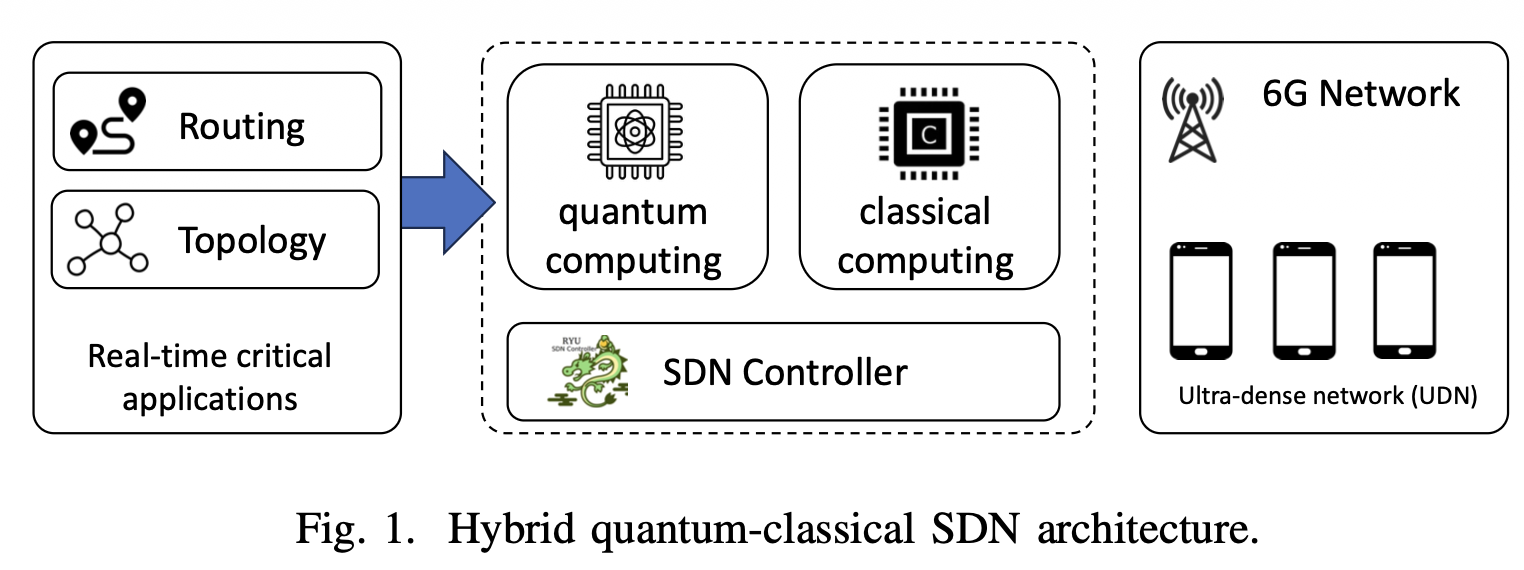
Fig. 1: Hybrid quantum-classical SDN architecture — combining quantum & classical computing at the controller level for 6G ultra-dense networks
II. Background
Quantum Computing & QAOA Fundamentals
Quantum Computing Basics
- Qubits exist in superposition of |0⟩ and |1⟩
- Entanglement links qubits over distances
- Enables parallel processing of multiple outcomes
- Potential breakthroughs in cryptography, optimization, material science
Combinatorial complexity of routing continues to increase. QC exploits quantum effects (superposition & entanglement) to boost computational power for NP-hard problems.
QAOA — Quantum Approximate Optimization
- Subset of Variational Quantum Algorithms (VQA)
- Suited for NISQ (Noisy Intermediate-Scale Quantum) devices
- Hybrid quantum-classical algorithm with parameters $(\beta, \gamma)$
- Encodes optimization into a Hamiltonian & seeks ground state
where $p$ = circuit depth, $H_C$ = cost Hamiltonian, $H_M$ = mixer Hamiltonian
QAOA Components
Encodes the optimization problem. Shapes the energy landscape where solutions correspond to energy levels.
Facilitates state exploration. Mitigates local optima by guiding the system through the energy landscape.
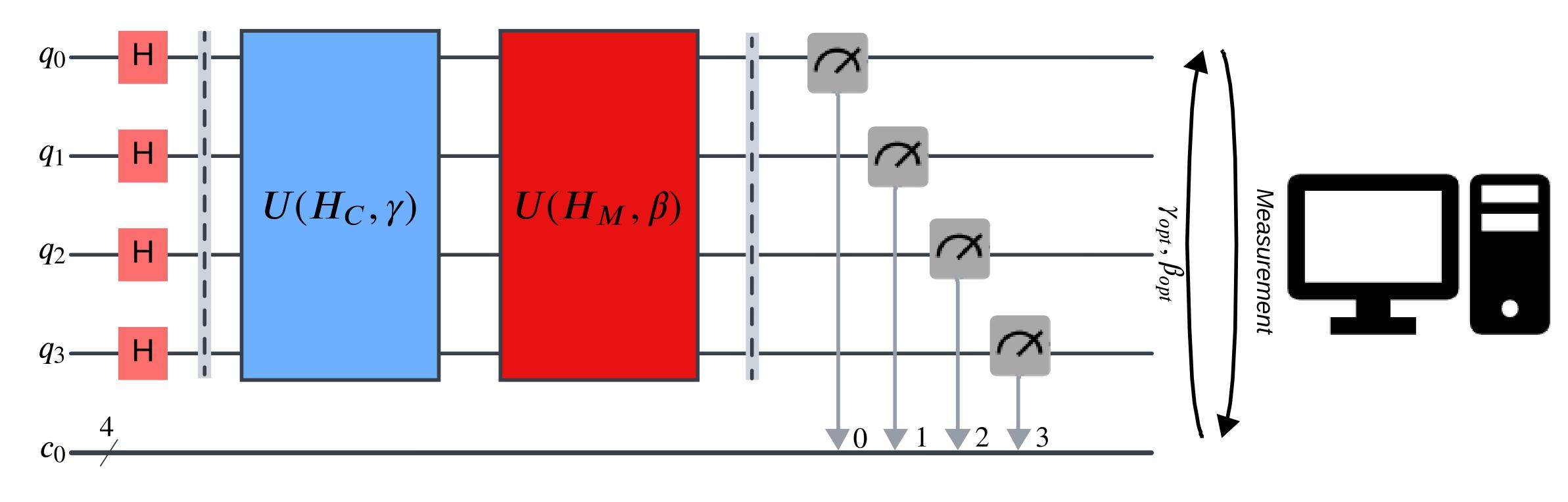
Fig. 3: QAOA scheme — Quantum Circuit Representation
III. Methodology
From Network Graph to Quantum Solution
Overall Framework Pipeline
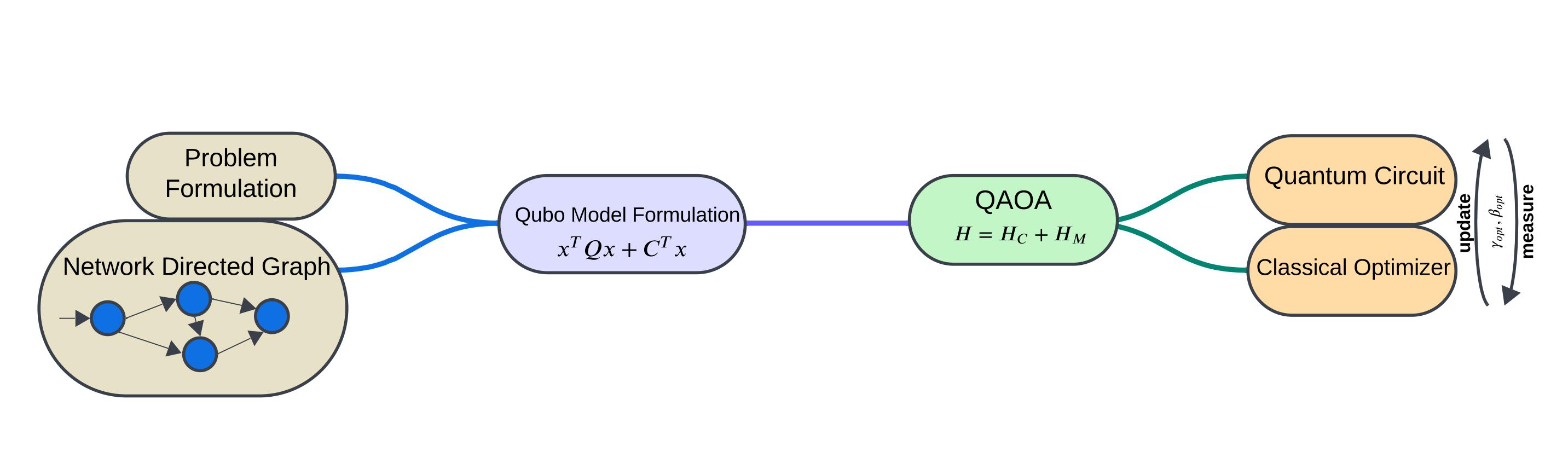
Fig. 2: Procedure for mapping the routing problem onto a gate-based quantum computer
Step 1: Problem Formulation
Network as Directed Graph $G(V, E, W)$
- $V$ — network nodes (routers, switches)
- $E$ — communication links
- $W$ — edge weights (latency, cost)
Cost Function
Minimize total travel distance/latency subject to constraints
• $n$ = number of qubits (dimensionality)
• $x$ = bit string representing a potential solution
• Each qubit $\leftrightarrow$ one binary decision variable
Step 2: QUBO Formulation
- $x$ — binary vector (0s and 1s)
- $Q$ — symmetric matrix (pairwise qubit interactions)
- $C$ — linear coefficients vector
$$\sum_{\text{incoming}} f = \sum_{\text{outgoing}} f$$
No accumulation of flow at any intermediate node.
Step 3: Objective with Penalty Terms
- $w_{ij}$ = link latency (cost)
- $X_{ij} \in \{0,1\}$ = link selection
- Constraints squared & added to objective
- Result: unconstrained quadratic binary problem
Quantum Circuit Implementation
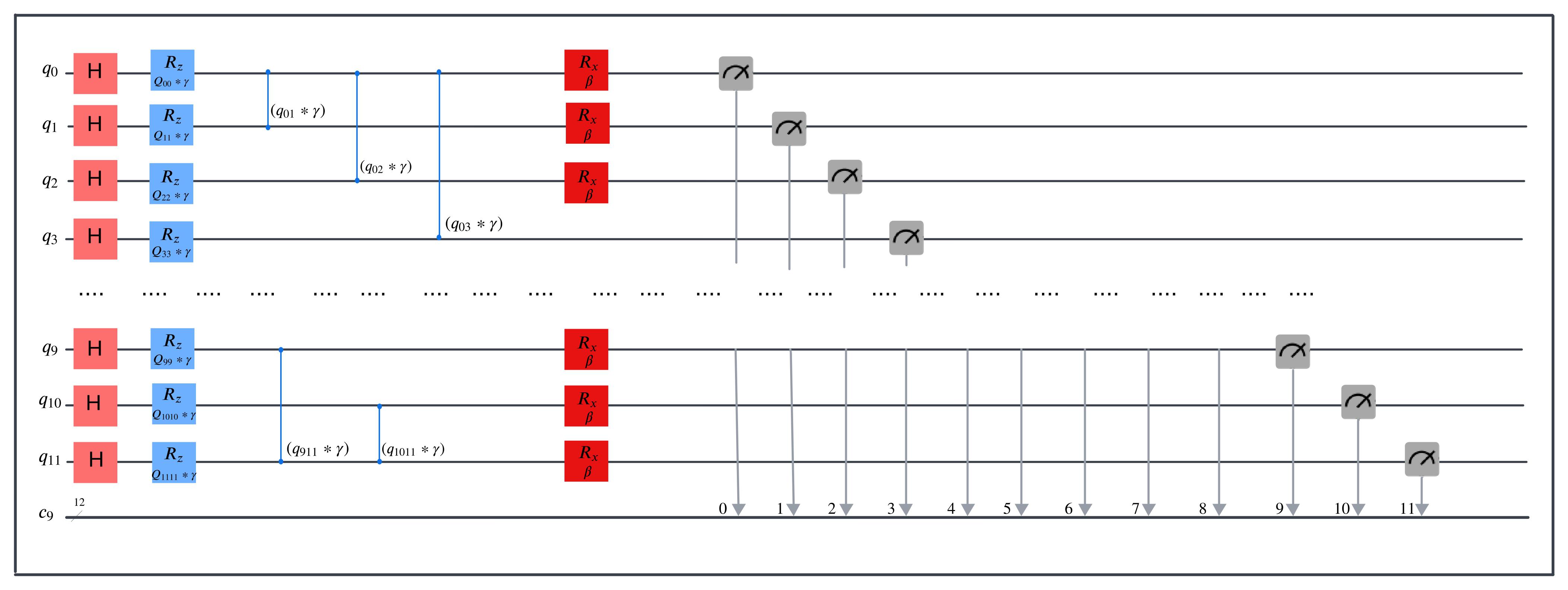
Fig. 5: Representation of QAOA Quantum Circuit (H1–H3) — 12 qubits
$R_{ZZ}$ gates Quadratic terms (qubit interactions)
H gates Initial equal superposition
IV. Experimental Setup
Simulation Environment & Configuration
Simulation Environment
Tools & Platform
- IBM Qiskit SDK for quantum simulations
- Microservices-based SDN controller (MSN)
- Based on Ryu SDN framework decomposition
- Classical optimizer: COBYLA
Configuration
- QAOA depth: $p = 1$ (single layer)
- 12 qubits per routing instance
- Penalty: $P = \sum w_{i,j} + 1$
- Optimizer: COBYLA (29 iterations)
Network Topology
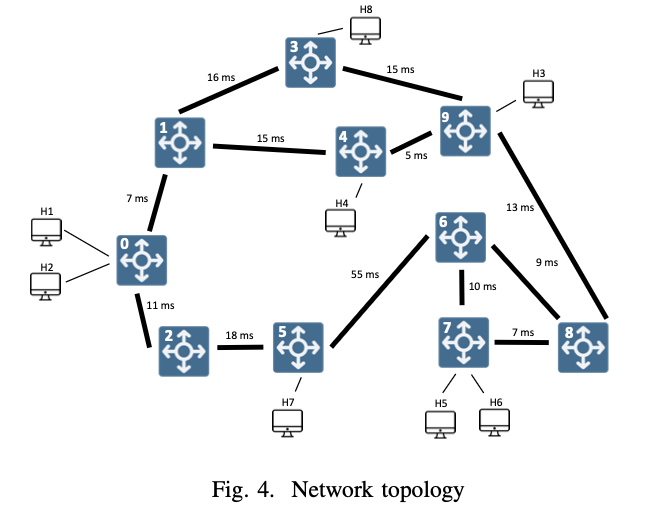
Fig. 4: Network topology — 10 nodes with link latencies (ms)
• H1 → H3: Source node 0 to destination node 9
• H7 → H8: Source node 5 to destination node 3
Edge weights represent link latencies (not representative of real-world — designed to test QAOA)
V. Results & Discussion
Proof-of-Concept Routing Optimization
Routing Example 1: H1 → H3
| Path (Nodes) | Binary Encoding | Cost | Probability |
|---|---|---|---|
| 0-1-4-9 | 100100100000 | 27 | 0.000942619... |
| 0-1-3-9 | 101001000000 | 38 | 0.000770757... |
| 0-2-5-6-8-9 | 010010010101 | 106 | 0.000742073... |
| 0-2-5-6-7-8-9 | 010010011011 | 114 | 0.000640327... |
Routing Example 2: H7 → H8
| Path (Nodes) | Binary Encoding | Cost | Probability |
|---|---|---|---|
| 5-2-0-1-3 | 111010000000 | 52 | 0.000348017... |
| 5-2-0-1-4-9-3 | 110111100000 | 71 | 0.000148433... |
| 5-6-8-9-3 | 000001010101 | 92 | 1.544e-05 |
Key Findings
- QAOA correctly identifies low-latency paths
- Accommodates flow constraints via penalty terms
- Only 29 iterations with single-layer QAOA
- Feasible on current NISQ hardware
- Limited qubit capacity constrains network size
- Noise in NISQ devices affects accuracy
- Single-layer depth ($p=1$) limits solution quality
- Small topology (proof-of-concept only)
VI. Conclusion & Future Work
Summary & Research Directions
Conclusion
Combined quantum-classical SDN framework for real-time routing in 6G networks
Successfully mapped routing as a QUBO problem solvable via QAOA
IBM Qiskit simulations confirm QC can identify feasible optimal paths
Extendable to larger, multi-constraint settings with hardware advances
Future Work
- Broader topologies — Scale to larger, real-world network graphs
- Multi-objective optimization — Include throughput, reliability, energy efficiency
- Noise mitigation — Evaluate error-mitigation for near-term quantum devices
- Distributed quantum controllers — Multiple QPUs for network segments
- Deeper QAOA circuits — Increase $p$ for better approximation quality
- Hybrid approaches — Combine with AI/ML-based adaptive routing
Thank You
Quantum-Enhanced Software-Defined Networking:
A Communication Perspective
IEEE INFOCOM 2025 Workshop
Contact: heurpe, jomondel@iteam.upv.es
swaraj_shekhar.nande, riccardo.bassoli, frank.fitzek@tu-dresden.de